
No products in the cart.

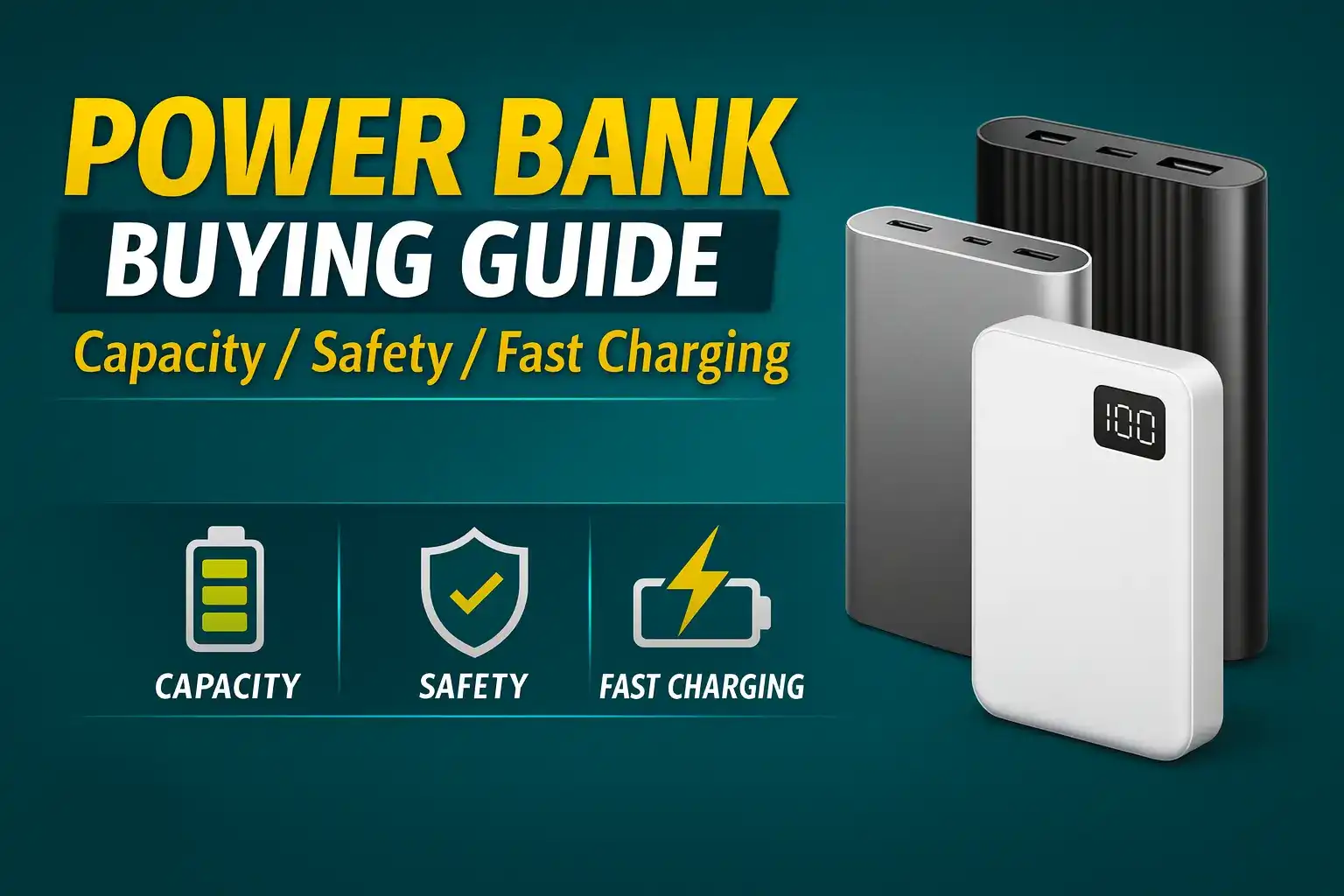
Power Bank Buying Guide – Capacity, Safety & Fast Charging Explained
By Zenkor
Introduction
A power bank is like a portable backup battery for your phone, earbuds, smartwatch or tablet. It is very useful during travel, office hours, power cuts and long journeys. But choosing the wrong power bank can lead to slow charging, overheating, battery damage or very low backup compared to what is written on the box.
This simple guide will help you choose the right power bank based on capacity, safety and fast charging support.
1. Understanding Power Bank Capacity (mAh)
Power bank capacity is written in mAh (milliampere hour), for example:
- 10,000 mAh
- 20,000 mAh
- 30,000 mAh
How Much Capacity Do You Need?
- 10,000 mAh: 1–2 full charges for most phones, good for light users or daily office use
- 20,000 mAh: 2–3 charges, ideal for travel or power cuts
- 30,000 mAh and above: 3–5 charges, good for heavy users or multiple devices
Why Real Backup Is Less Than Written mAh?
For example, a 10,000 mAh power bank usually gives around 6,000–7,000 mAh of real usable backup. This is because of:
- Power conversion loss
- Heat loss
- Cable loss
- Internal circuit usage
Simple rule: Real backup is usually around 60–70% of written capacity.
2. Power Bank Output – Watt (W) & Ampere (A)
Just like chargers, power banks have different output power levels, such as 10W, 12W, 18W, 22.5W or 33W.
Which Output Is Best?
- 10W–12W: Basic, slow but safe charging
- 18W–22.5W: Fast charging for most smartphones
- 33W and above: Very fast charging for supported models
If your phone supports fast charging, choose a power bank with at least 18W output.
3. Number & Type of Ports
Modern power banks usually offer a mix of:
- USB-A ports: For standard charging cables
- USB-C port: Often supports both input and output
- Micro USB port: Sometimes used for charging the power bank itself
Best Setup
- At least 2 output ports so you can charge two devices together
- A USB-C port with fast charging support for new smartphones
4. Fast Charging Support (PD & Others)
If your phone supports fast charging, the power bank should also support compatible fast charging technology.
PD (Power Delivery)
- Common fast charging standard for many smartphones, tablets and laptops
- Popular output levels: 18W, 20W, 22.5W, 30W, 45W, 65W
For most users, a power bank with 18W–22.5W PD support is more than enough for daily use.
5. Safety Features – Very Important
A cheap and unsafe power bank can be risky. Always check for built-in safety features like:
- Over-charge protection
- Over-discharge protection
- Short-circuit protection
- Over-voltage protection
- Over-current protection
- Over-temperature protection
These protections help keep your phone, your power bank and you safe.
6. Battery Type Inside the Power Bank
Most power banks use either:
- Lithium-ion cells
- Lithium-polymer (Li-Po) cells
Lithium-polymer designs are usually slimmer and offer better thermal control, but both can be good if the product is well-built.
7. Weight & Size – How Portable Is It?
- 10,000 mAh: Light and pocket-friendly
- 20,000 mAh: Slightly heavy, better for bags
- 30,000 mAh+: Heavy, mainly for travel bags or home backup
For daily carry, 10,000 mAh or 20,000 mAh is usually the best choice.
8. How to Estimate Charging Cycles
Example: Phone battery = 5,000 mAh Power bank = 10,000 mAh
Realistically, you can expect around 1.5 full charges, not 2, because of conversion and energy loss.
With a 20,000 mAh power bank, you may get around 3 full charges for a 5,000 mAh phone under good conditions.
9. Input Charging – How Fast the Power Bank Itself Charges
Also check how quickly the power bank recharges itself.
- Input type: USB-C is usually the fastest and most convenient
- Input wattage: Higher wattage = faster recharge time
Example for a 10,000 mAh power bank:
- With 10W input: takes about 4–5 hours
- With 18W input: takes about 2.5–3.5 hours
10. Indicator & Display
Power banks show remaining battery in two ways:
- LED indicators (4 dots for 25%, 50%, 75%, 100%)
- Digital percentage display (more accurate)
11. Important Usage & Safety Tips
- Do not leave the power bank in direct sunlight or inside a hot car
- Stop using if the power bank becomes too hot
- Avoid overcharging it for very long periods
- Use good quality cables for charging
- Do not keep heavy items on top of the power bank
- If it swells or smells burnt, stop using it immediately
12. Common Myths About Power Banks
- Myth: Higher mAh is always better
Truth: You should balance capacity with safety, weight and quality. - Myth: Any cheap cable is fine
Truth: Poor cables reduce speed and may damage the charging port. - Myth: Power banks always damage phone batteries
Truth: A good quality, safe power bank is like a normal charger.
Final Recommendation
- Choose 10,000 mAh or 20,000 mAh based on your usage
- Prefer at least 18W fast charging output
- Look for multiple protection features
- Use proper cables for best speed and safety
- Check size and weight if you want to carry it daily
Conclusion
A power bank is not just an emergency backup; it is your power partner when you are away from a wall socket. If you choose it carefully with the right capacity, safety features and fast charging support, you will never have to worry about low battery again.
Choose wisely, stay charged and stay connected.




Add comment